When Google quietly (or so they thought) killed the &num=100 parameter last week, the SEO tool industry revealed its true colours. Some providers immediately started telling their users “you don’t really need that data anyway.” Others rolled out corporate damage control faster than you could say “premium pricing.”
And then there’s the fabulous SE Ranking*, who simply said “we know you need this, so we’re keeping it” and got on with the job.
I’m not going to lie to you – I’ve been an SE Ranking fangirl for a long time. I use it to track my own rankings, and all of my clients. I use it for keyword research, competitor research, and as an awesome start to a technical SEO audit. So it should come as no surprise to you that I’m sucking up to them again. #SorryNotSorry
And I think the way they have handled this whole &num=100 thing is an example of perfect PR.

The corporate spin from Ahrefs and SEMrush
When Google removed the ability to fetch 100 search results in one go, most ranking tools suddenly couldn’t track positions beyond the top 10 without making ten times as many requests. That’s expensive, slower, and (quite frankly), a massive pain in the arse for them.
So how did the big players respond?
Ahrefs: “You don’t need it anyway”
Tim Soulo from Ahrefs essentially told everyone that tracking beyond position 20 is just “an indication that a page is indexed by Google” with no truly actionable use cases. Top 10 is where the traffic is, top 20 is where opportunity sits, but everything beyond that? Apparently useless.
Do you need keyword ranking data below Top20?
— Tim Soulo 🇺🇦 (@timsoulo) September 15, 2025
Because it's likely going away…
You might've heard the news – Google is dropping the "&num=100" parameter, which allowed SEO rank tracking tools to pull the top 100 search results in a single page load.
Ramping up the data pulls… pic.twitter.com/fIfTgGZGXw
SEMrush: “The data that matters most is still intact”
SEMrush went with the classic corporate reassurance approach. They acknowledge the issue impacts “all rank tracking tools” but want you to know that rankings beyond top 20 “should be seen as supplementary insights rather than critical decision-making signals.”
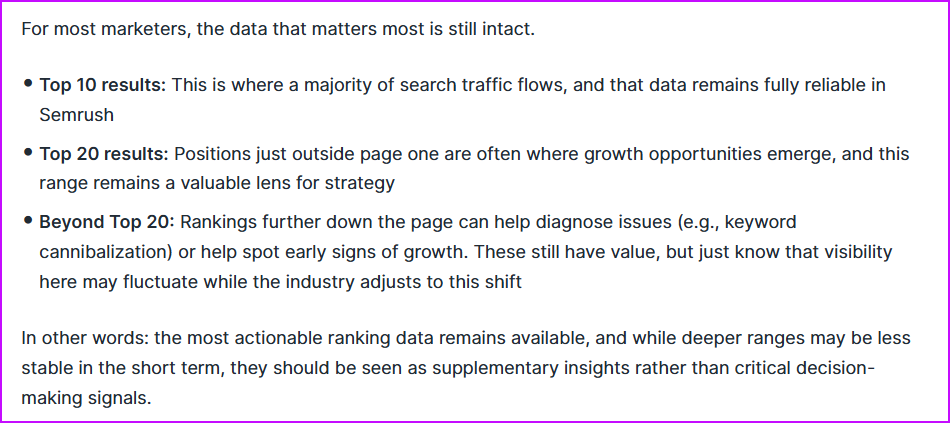
Both responses read like damage control from companies trying to stop clients jumping ship. They’re literally telling you that you don’t need something you’ve been paying for, purely because it’s now more expensive for them to provide it.
SE Ranking’s response to the changes
Mike Korenugin from SE Ranking posted a refreshingly honest take: “The top 100 has always mattered. Saying it doesn’t matter sounds more like an excuse for not being able to provide the data anymore.”
Couldn’t have said it better myself (although, I would probably have sworn more, let’s be honest)
SE Ranking seem to have accepted that yes, it costs them more resources to track beyond position 20, but they’re continuing to do it anyway because that’s what their users need. They acknowledge it takes longer to process and display, and there might be some temporary issues whilst they scale up, but they’re committed to providing the complete data.
This is why SE Ranking is my SEO tool of choice*, and why I recommend it to every client who asks.
Why tracking the full top 100 ranking positions matters
Let’s talk about why positions 21-100 aren’t just vanity metrics, despite what Ahrefs and SEMrush want you to believe.
Tracking progress on new content
When you publish new content, it doesn’t (always) magically appear in position 5. It usually starts somewhere around position 60-80 and gradually climbs. If you can’t see beyond position 20, you’ve got no idea if your new content strategy is working until it suddenly appears on page two months later.
Being able to track a keyword climbing from position 95 to 65 to 42 over several weeks tells you that your content is gaining traction. That’s valuable intelligence for planning your next moves.
Understanding the competitive landscape
Knowing which competitors rank where for your target keywords helps you understand the full competitive picture. If you can only see positions 1-20, you’re missing crucial context about who else is targeting those keywords and how strong their content is.
Position 45 today could be position 15 tomorrow if your competitor suddenly does some SEO work. You need to see the full battlefield, not just the front line.
Identifying keyword opportunities
Sometimes the best opportunities are keywords where you’re already ranking, but at position 35. A bit of optimisation, a few decent internal links, and you could jump to page one. But if you can’t see beyond position 20, you’ll never know these opportunities exist.
I’ve had clients ranking at position 40 for high-value keywords they didn’t even know they should be targeting. A quick content update pushed them to position 8 within weeks. That’s money in the bank that they’d have missed entirely if they couldn’t track the full top 100.
Diagnosing technical issues
If a page suddenly drops from position 12 to position 67, that’s a red flag suggesting a technical problem or penalty. But if you can only track to position 20, that page just “disappears” from your rankings. You might not notice it’s gone for weeks, by which time the damage is done.
Measuring the impact of algorithm updates
When Google rolls out an update, seeing how your rankings shift across the full top 100 gives you a complete picture of the impact. Did you lose visibility on page one but gain loads of positions on page two and three? That’s valuable information for understanding what Google’s looking for.
Client reporting and expectation management
Try explaining to a client why you can’t show them movement on keywords they’re tracking just because they rank at position 25. “Sorry, we can only see the top 20 now” sounds like you’ve downgraded their service without reducing the price.
Being able to show complete ranking data demonstrates progress even when you’re not yet on page one. Clients can see their investment is working as rankings gradually improve.
The real cost of incomplete data
What Ahrefs and SEMrush are essentially doing is reducing the value of their service whilst maintaining (or likely increasing) their pricing. They’re trying to convince you that you don’t need something you’ve been paying for all along.
It’s like your gym removing half the equipment and telling you that you didn’t really need those machines anyway, the treadmills are where all the results come from. Would you accept that?
The SEO professionals I know need complete ranking data. We need to see movement patterns, identify opportunities, track progress on new content, and understand the full competitive landscape. Twenty positions just doesn’t cut it when you’re managing a comprehensive SEO strategy.
Regular readers already know I think Google owes the SEO industry nothing – but the SEO tools that we pay for? They most certainly fucking do.
Why this makes SE Ranking the obvious choice
This whole situation has revealed something important about different tool providers’ priorities.
SE Ranking could have taken the easy route. They could have joined Ahrefs and SEMrush in telling everyone that positions beyond 10 or 20 don’t matter. They could have saved themselves significant money and processing power.
Instead, they chose to invest in their infrastructure, absorb the higher costs (for now, I realise this may change), and continue providing the complete service their users need. That’s the kind of company you want to do business with.
Their tool might take a bit longer to process full ranking data now. There might be occasional hiccups whilst they scale their systems. But they’re being transparent about these challenges whilst working round the clock to solve them.
Compare that to competitors who are essentially trying to gaslight their users into believing they never needed complete data in the first place.
For me, the choice is obvious. SE Ranking* has proved that they value their users more than their short term profit margins. They’ve shown they’re willing to invest in their service rather than reduce it. And they’ve demonstrated the kind of transparency and honesty that’s refreshingly rare in the SEO industry.
*In the interests of transparency, all SE Ranking links are my affiliate link. I also have a SEMRush affiliate link, but have chosen not to use it, which should tell you a little about the companies I choose to make affiliate commission from.