In early June, Google added a new report to Search Console showing how often your pages appear in its AI search features. And almost immediately, people started asking the same question: why is this number so much lower than I expected?
Google has now answered that, and the answer tells you quite a lot about what these reports can and can’t do. If you’re going to look at this data (and you should, occasionally, without obsessing), it’s worth understanding what you’re looking at.

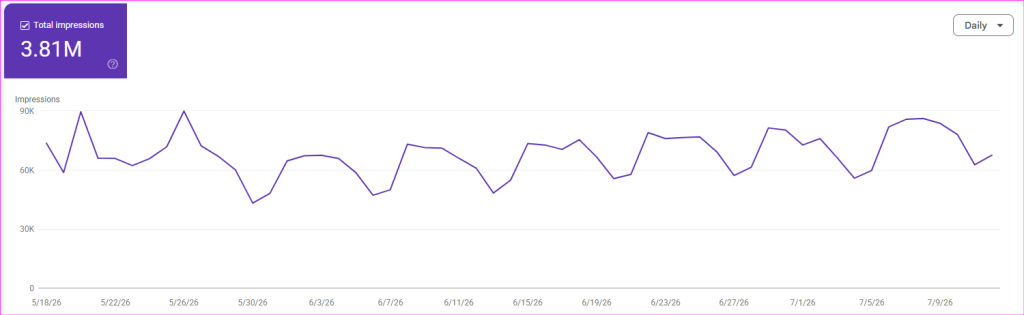
What the new generative AI performance report shows
The report covers your appearances in AI Overviews (the AI-written summaries at the top of some search results) and AI Mode (Google’s more conversational, chat-style search). For now it shows impressions only – no clicks, no queries, no positions, though Google says those are coming. It also lumps AI Overviews and AI Mode together into one figure, so you can’t tell which one you’re appearing in.
It’s rolling out gradually, and helpfully for those of us on this side of the pond, UK websites are getting it first – Google is testing it here before rolling it out globally. So there’s a reasonable chance it’s already sitting in your Search Console waiting for you. The data starts from 18 May 2026, so don’t expect any history before that. And if you’re wondering whether this data is new – it isn’t, quite. Your AI appearances were already counted inside your normal search totals. This report separates them out so you can see them separately.
What counts as an impression in AI search results
This is the bit Google’s John Mueller clarified recently, and it’s the bit most people have wrong.
An impression is counted when a link to your website is shown to a user in an AI Overview or AI Mode response. A link. Not a mention of your business name. If Google’s AI writes three glowing sentences about your company but doesn’t link to your site, that’s zero impressions in this report.
There are two other quirks worth knowing. If the link to your site sits behind something the user has to click or expand before they can see it, the impression only counts when they do that. And if your page appears in the AI Overview and in the ordinary blue links on the same results page, that’s counted once, not twice.
So the number in your report is pretty conservative. It’s the times a visible, clickable link to your site was put in front of someone inside an AI answer.
What the numbers don’t tell you
The gaps matter as much as the data.
Unlinked brand mentions are invisible to this report entirely – and in AI answers, mentions without links happen a lot.
There’s no click data yet, so you can’t see whether any of these appearances brought anyone to your website.
And because AI Overviews and AI Mode are blended together, you can’t tell whether you’re showing up in the summaries most people see or the chat mode fewer people use.
I covered a related problem in AI Overviews are up 58% – and everyone’s reporting it wrong – AI search data has a habit of being technically accurate and easily misread at the same time. This report is no exception.
Why your AI visibility might be bigger than Search Console suggests
Because impressions only count links, your presence in AI answers is almost certainly larger than this report shows. Every time an AI response mentions your business without linking, that’s visibility – a potential client reading your name – that Search Console simply cannot see.
This is also why third-party “AI visibility” tools show completely different numbers from Search Console. Most of them track mentions – how often your brand name appears in AI answers – which is precisely the thing Google’s report ignores. Neither is lying to you. They’re measuring different things. But if someone shows you a scary gap between the two as evidence you need their services, now you know why the gap exists. (Bing, incidentally, went a different way – its Webmaster Tools shows citation counts, which I wrote about in Bing Webmaster Tools now shows how often AI cites your content – here’s what you need to know.
What to do with the report
Have a look when it reaches your account, and treat the impressions as confirmation that AI features are citing you, rather than as a traffic metric – because it isn’t one yet. If the number is small, that’s normal, partly because of the strict counting rules above and partly because AI features still drive far less activity than ordinary search results.
The sensible move is to note your baseline now. When Google adds click data later, you’ll want something to compare it against. Beyond that, carry on as you were. The content that earns links in AI answers is the same content that ranks well everywhere else, and no separate strategy is required – just a slightly better-informed raised eyebrow when someone quotes AI visibility numbers at you.
Need help working out what’s working and what’s not in your SEO? My 1:1 sessions are designed for this.