
SEO success for a Squarespace healthcare network website
Twenty years of content, a tangled redirect file and a blog post Google loved for all the wrong reasons
This client is a network of independent occupational therapists working across the UK. Local authorities, schools, case managers and families use the site to find an OT near them, and OTs use it to find out about joining the network. It runs on Squarespace and has been building up content for nearly twenty years.
Matthew, who runs the network, got in touch in spring 2026. He’d been let down by SEO before, so he wanted someone who would explain what they were doing and keep him in the loop. The site was ranking for some regional searches. He wanted it working harder for the people most likely to pick up the phone, and a clear idea of what was worth doing.
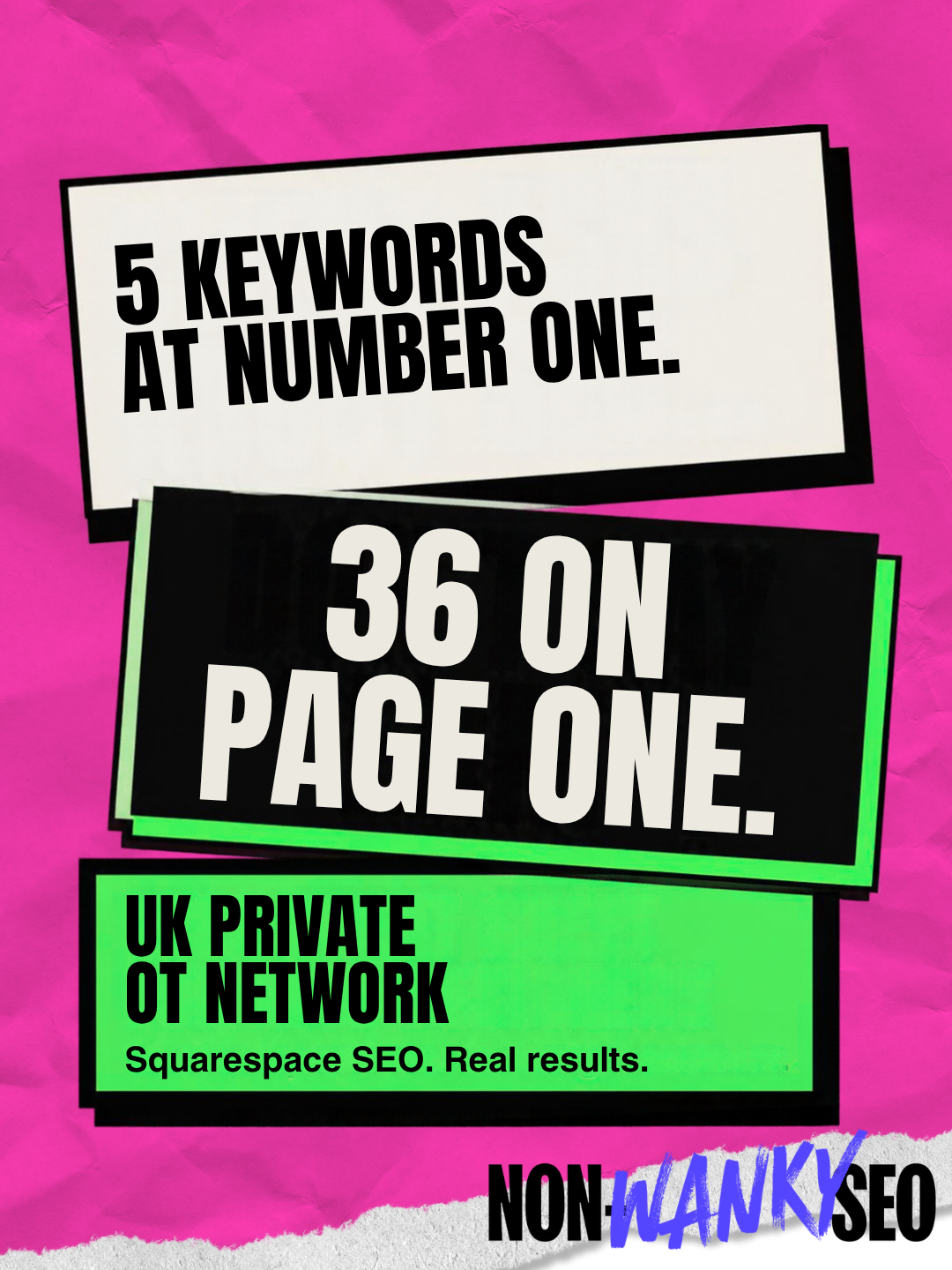
Tracked keywords at number one in Google
Tracked keywords on the first page
Contact form submissions in the first full month of tracking
Clicks from Google in month six
Why Google thought the site was about something else
Before touching anything, we went through the traffic and search data. One old blog post, explaining the meaning of the word in the business name, was getting more visibility than the rest of the site put together.
None of those people wanted an occupational therapist. They arrived, found something they weren’t looking for, and left. Worse, they were telling Google the site was about the meaning of a word rather than OT services.
So we took it down. The traffic graphs dropped, which I’d warned Matthew about before we did it. What was left was a true picture of who was visiting, and the time people spent on the site went up straight away.
Not sure what Google thinks your website is about? That’s where I’d start.
See my SEO servicesFixing technical SEO problems on a Squarespace site
This was the biggest single chunk of the work. Twenty years of pages being added, moved and renamed had left a lot of mess underneath.
The redirect file was the worst of it. Old addresses were bouncing through two or three other addresses before reaching a live page, and some were going round in circles through pages that no longer existed. We untangled more than 70 of those chains, removed the duplicates and sorted the file so anyone opening it later can see what goes where. Hundreds of internal links still pointed at old addresses, so those were updated to go straight to the right page.
Search Console had its own list of problems: broken pages, canonical errors, and dozens of pages Google had found but never added to its index. We fixed what needed fixing, resubmitted the pages that deserved to be in search, and kept pages like the cookie policy and thank you page out of it. Every service page got new meta titles, descriptions and headings written around what people search for. Pages nothing else linked to were either linked in properly or removed, and images got alt text across the site.
- Redirect chains untangled
- Old internal links pointed at live pages
- Search Console errors cleared
- Pages resubmitted for indexing
- Titles and headings on every service page
- Orphan pages linked in or removed
Squarespace SEO warnings you can’t fix from the dashboard
Squarespace does a few things that SEO audit tools complain about, and nobody can change them from the dashboard. Rather than leave Matthew to panic every time an audit flagged them, we wrote them down as known, harmless and not worth paying anyone to chase.
Making the site say “private occupational therapy” clearly
The keyword research split the audience into four groups: people looking for a private OT, parents and schools looking for children’s OT, housing and home assessments, and searches for an OT in a particular area.
The homepage was rewritten so Google could see straight away that this is a network of private and independent OTs. The service pages and the regional “find an OT” pages were updated with the words people type in when they’re ready to make contact.
Rewriting twenty years of blog content
The blog went back to 2007, and it showed. Some posts had been copied from other organisations, including a US government job description, which explained why American terms kept turning up. Others still talked about laws and regulators that had been replaced years ago, which isn’t a great look on a healthcare site.
We merged posts covering the same ground into one stronger post each, deleted and redirected the ones past saving, and rewrote the rest in the network’s own words. Each rewrite came with a short list of clinical points for Matthew to check, so he wasn’t proofreading whole posts to find the two lines that needed an OT’s eye.
Counting enquiries for the first time
When we started there was no way to see how many people got in touch through the website. We set up tracking in Google Analytics for form submissions, email clicks and the “get in touch” button.
In the first full month, the contact form was used nearly 30 times. Some of those are OTs applying to join the network, and for a network that is always recruiting, the careers page bringing in applications is part of the job.
SEO results after six months
By month six, five of the terms we tracked were at number one in Google and 36 were on the first page. The searches people use when they’re ready to hire a private OT were sitting in the top ten, and the children’s OT searches, the most competitive area, were climbing steadily.
In month six, clicks from Google rose by more than half, even though the site appeared in fewer searches. That’s the result we were after: fewer people wandering in by mistake, and more of the right people clicking through when the site turned up. Month six fell in September, when visits always pick up after the summer, but this rise was bigger than seasonal.
- Five keywords at number one
- 36 keywords on page one
- Private OT searches in the top ten
- Click-through rate nearly doubled
Handing over SEO work at the end of a project
This was a six month project. Having been let down by SEO before, the last thing Matthew needed was someone fading out at the end with everything still in their head.
He got a handover document covering what to do and what to leave alone, a checklist for whoever writes the next blog posts, and a single list of the decisions still waiting on him. Their LinkedIn person got a guide to republishing blog posts as LinkedIn articles. We’re still keeping an eye on Search Console and the rankings, so when Matthew comes back to it there’s a clear picture of what happened.
What Matthew said
Years of content piling up? Let’s work out what’s helping.
If you’re not sure what’s working on your website and what’s getting in the way, half an hour on a call and we’ll work out where to start.
Book an enquiry call