
Google dropped something unexpected today. The SEO world has been watching SERP volatility for days, bracing for a standard core update. Instead, Google announced the February 2026 Discover core update – a core update targeting only Google Discover.
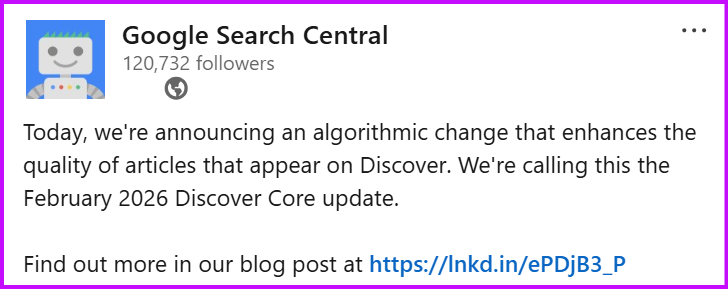
This is the first time Google has released a core update specifically for Discover. That’s worth paying attention to, whether you get Discover traffic or not.

What Google Discover is and why most small businesses don’t use it
Before we go any further – Google Discover is the personalised content feed that shows up on the Google app and mobile homepage. It surfaces articles, videos, and posts based on what Google thinks you’re interested in, without you searching for anything.
If you’re a B2B service business with a website and a blog, you probably don’t get much (if any) Discover traffic. It tends to favour news publishers, large content sites, and trending topics. You can check whether you’re getting Discover traffic in Google Search Console – there’s a separate Discover report under Performance.

If you don’t see a Discover tab there, you’re not getting Discover traffic. And that’s fine. Most small business websites don’t.
What this update changes for sites that DO get Discover traffic
Google says the update will improve Discover in three ways:
Showing users more locally relevant content from websites based in their country. Reducing sensational content and clickbait. And showing more in-depth, original, and timely content from websites with demonstrated expertise in a given area.
That last bit is interesting. Google specifically said their systems evaluate expertise on a topic-by-topic basis, not site-wide. Their example was a local news site with a dedicated gardening section – it could be recognised as having gardening expertise even though it covers loads of other topics. But a movie review site that published one gardening article probably wouldn’t.
If you do get Discover traffic, this is a signal that depth and consistency in your subject areas matters more than ever.
This is NOT a search core update
I need to stress this because some corners of the SEO world are already getting it wrong.
Some sites have been predicting a February core update based on ranking fluctuations over the past few days. When Google made today’s announcement, a few jumped on it as confirmation – lumping it in with predictions about AI content crackdowns, topical authority changes, and search ranking shifts.
That’s not what this is. Google’s announcement is specifically about Discover. The Search Status Dashboard lists it as a Discover update. Google’s blog post talks exclusively about Discover. John Mueller Google’s Search Advocate (basically the guy who speaks to us plebs!) posted it under Discover guidance.
If your search rankings change over the next two weeks, it’s not because of this update. Could there be a separate search core update coming? Maybe. But this isn’t it.
What this means for UK businesses
The update is rolling out to English-language users in the US first, with plans to expand to other countries and languages in the coming months. So if you’re a UK business, this won’t affect you immediately.
When it does roll out to the UK, the “locally relevant content” focus could be interesting. It suggests Google wants Discover to surface more content from websites based in the user’s own country rather than defaulting to US-centric results. For UK publishers and content creators who do get Discover traffic, that could be a positive shift.
What you should do right now
If you don’t get Discover traffic – nothing. Carry on as you were.
If you do get Discover traffic – keep an eye on your Search Console Discover report over the next couple of weeks. Don’t panic if numbers fluctuate. And definitely don’t start making changes to your website based on daily traffic movements during a rollout.
The broader takeaway for everyone is that Google is now treating Discover’s quality signals separately from Search. That’s a shift in how they’re thinking about content surfacing, even if it doesn’t directly affect your rankings today.
Want to stay on top of Google updates without the panic and misinformation? Sign up for my newsletter – I’ll tell you what matters, what doesn’t, and what you can safely ignore.