(This is the 19/08/2025 issue of my newsletter – subscribe here)
Hey hey!
Well, this week was supposed to be different. I’d booked myself three glorious days off for some much-needed R&R. How’s that going? About as well as you’d expect when you work in SEO and everything is “an emergency” (it’s not, but I’m a sucker for helping out).
Anyway, while I’ve been dealing with emergency website migrations and wrestling with content management systems, Google’s been busy launching a new feature that’ll probably land in the UK soon.
They’ve rolled out “preferred sources” in the US and India, which lets people customise their news results to see more content from sites they trust and follow.
Meanwhile, Gary Illyes has clarified (again) that Google doesn’t care if content is AI-generated, but it should be human-reviewed – as long as “the quality and accuracy of the content” is high, the creation method doesn’t matter. There’s still a massive difference between “AI is OK” and “AI content at scale” though – read my article about the difference before you do anything daft.
Oh, and I’ve added a shiny new AI search module to my non-wanky SEO course – prices are going up in September, but anyone who signs up now gets lifetime access, including all future updates and modules.
What you’ll find inside
1 | Thoughts: Why the AI misinformation feedback loop is getting out of hand
2 | Blog post: The truth about code minification and why you’re wasting your time
3 | Free SEO tip: A quick and easy way to find content and FAQ ideas
4 | Blog post: Why your real competition isn’t who you think it is
Let’s dig in, shall we?
Thoughts this week
The amount of AI search crap out there shows no signs of slowing down, and it’s feeding its own cycle of bollocks.
Some SEO gooroo writes a post claiming “AI search is going to destroy traditional SEO” (it’s not.). That post gets shared, quoted, and recycled across social media, in other blog posts, in articles, and more. Then AI tools scrape all this nonsense and start regurgitating it as fact when people ask questions about AI search.
So now we’ve got LLMs trained on misinformation, spitting out more misinformation, which gets shared by people who don’t know any better, which then gets scraped by more AI tools. It’s like a digital game of Chinese whispers, except the whispers are getting louder and more confident each time.
And it pains me to see that people are making business decisions based on this recycled shite. I’m seeing companies panic about “optimising for AI search” using tactics that don’t exist, or abandoning perfectly good SEO strategies because some AI tool (or some tool on LinkedIn) told them traditional SEO is dead.
It seems I’m not the only one:
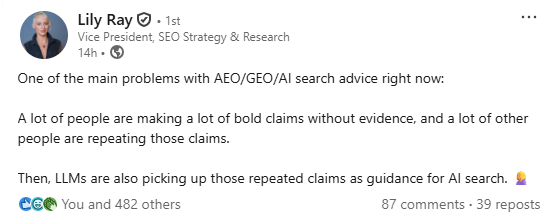
FFS, the actual data still shows that AI search drives less than 1% of traffic for most websites, and good old-fashioned SEO fundamentals work just fine for AI search visibility. But try explaining that when every AI assistant is confidently spouting the same recycled shit about “awesome” new “strategies” that nobody needs.
Stop obsessing over code minification
My recent blog post tackles one of the most pointless SEO myths doing the rounds – the idea that you must minify every single piece of code on your website. The reality is you’re probably wasting time compressing 2KB files whilst your site loads slower than dial-up.
If your hosting is slower than a sedated sloth and your images are bigger than your mortgage, minifying tiny CSS files isn’t going to save you. Focus on the big performance killers first – decent hosting, optimised images, proper caching. The micro-optimisations can wait until you’ve sorted the stuff that matters.
Your free SEO tip
Stop staring at blank screens wondering what to write about. Google’s “People also ask” boxes are a goldmine of content ideas that your audience is literally searching for.
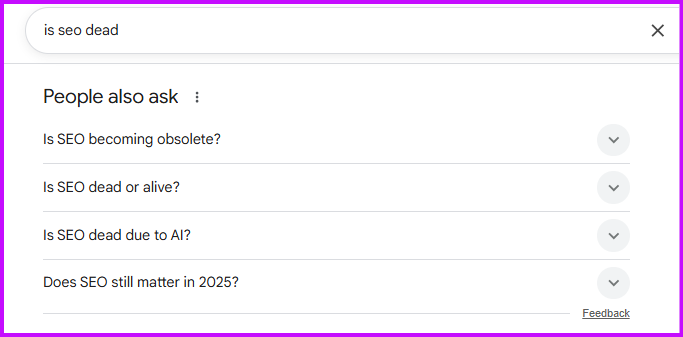
Search for a keyword related to your business, scroll down to the “People also ask” section, and click on the relevant questions to expand the list. You’ll find dozens of blog post ideas in minutes. I wrote a really quick guide on how to do this – it’s one of the easiest ways to never run out of content ideas again.
(Also check out Also Asked – aff link – their paid version is one of my go to research tools for so much more than blog ideas and FAQs.)
Your real competition isn’t who you think
My other recent post digs into something most businesses get completely wrong – who they’re actually competing against. It’s not just other agencies or freelancers doing similar work.
You’re competing against DIY solutions, internal handling, free advice, and the biggest competitor of all – people doing absolutely nothing. That potential client who ghosts you after a brilliant discovery call? They’re not choosing a competitor. They’re choosing the familiar mess they know over the unknown solution you’re offering.
Understanding this changes everything about how you approach your marketing, SEO strategy, and content creation. Stop fighting battles in a vacuum and start addressing the real alternatives your prospects are considering.
What am I working on?
This week I’m still fixing errors in a website migration I came in to rescue at the last minute (so much for that holiday), and working with my auction website client to make their new site look as amazing as their copy. We’re moving content around in the CMS and tweaking all those niggly little bits that just won’t fit properly. It’s meant a lot of Zoom coworking sessions, and a constant thread of chat on layout, CTAs and UX improvements.
This is what proper SEO copywriting looks like – I’m not just handing over copy and disappearing. I’m there for the whole process, including the fiddly bits that make the difference between copy that works and copy that converts.
Plus I’m trying to take some actual time off for R&R. It’s not going well, but I’m optimistic about today.
Need help with any of the above? You know where to find me.
Always non-wanky,
Nx
P.S. Give that “People also ask” tip a try and let me know how you get on – it’s brilliant for finding content gaps you didn’t even know existed.