
Google has been classifying search queries into categories for years. Every time someone types something into the search box, Google isn’t just matching words – it’s making a judgement about what kind of query this is, what the person is actually trying to do, and what kind of content will best serve them. That classification influences what results it shows, what SERP features appear, and how your content needs to be structured to have a chance of ranking.
You’ve probably heard it talked about as Search Intent.
The interesting thing is that Google has never told us directly how it does this. Until recently, it’s been something SEOs inferred from observing patterns in search results rather than something we could measure directly.
That changed when SEO genius, the fabulous Mark Williams-Cook, founder of digital agency Candour & SEO tool Also Asked, published details of a Google exploit that revealed the classification system Google actually uses – eight distinct query categories, each with its own characteristics.
Mark has since built a free tool at QueryClassifier.com that runs your keywords through a model trained on 4.8 million English queries and category pairs from that exploit data, and tells you which category Google is likely to put each one in.
I’ve been playing with it, and honestly, it’s really useful. With one caveat, which I’ll come to.
If you want to connect with Mark on LinkedIn to follow his work, you can find him here.

What the eight query classes mean for your content
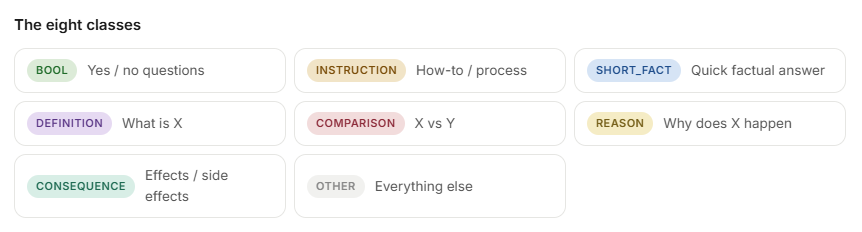
Before you run your own keywords through the tool, it helps to understand what each class actually means in practice – not just the label, but what Google expects to see on a page targeting that type of query.
BOOL – yes or no questions
These are queries where someone wants a definitive yes or no answer. “Do I need an HR consultant?” “Is SEO profitable?” “Is SSL free?” The reader isn’t looking for a nuanced essay, they want an answer, ideally in the first sentence, followed by the context that supports it. If your page targeting a BOOL query buries the answer three paragraphs down after a dull as fuck lengthy introduction, you’re working against what Google expects for this query type.
SHORT_FACT – quick factual answers
People typing this into Google want a specific piece of information. “How much do plumbers charge per hour?” “What are the qualities of agood salesperson?” The answer should be direct and (again) appear early in the content. Google is very likely to pull this into an AI Overview or featured snippet, so if you want to be cited, lead with the fact. Supporting detail can follow, but don’t make people dig for the core answer.
DEFINITION – what is X
Exactly what it sounds like. A person searching this wants something explained. “What is programmatic SEO?” “What is topical authority?” These pages should open with a clear, direct definition, then expand on it. Structure matters here – Google knows what a definition page looks like, and pages that meander into tangentially related territory before getting to the point tend not to perform as well as pages that answer the “what is” question cleanly and then build on it.
INSTRUCTION – how-to and process queries
The reader wants to know how to do something. “How to get into SEO.” “How to set up Google Search Console.” These pages should be structured around steps or a clear process. Chronological order matters. Google tends to show these in formats that make the process scannable – if your instructional content is written as flowing prose with no clear progression, it’s harder for Google to understand and present it effectively.
COMPARISON – X vs Y
Behind this query is a person who is weighing up options. “What is the difference between HR and HR consultants?” “SE Ranking vs Ahrefs.” The content needs to genuinely address both sides. Google’s classification here is useful because it tells you the person has already narrowed down their options and wants help choosing – which means your content should be structured around the decision, not around selling one option. (This also explains why self-promotional comparison pages perform poorly – they’re structurally misaligned with what Google expects a comparison page to do, and usually spammy as fuck.)
REASON – why does X happen
This is a query from someone who wants to understand causation or explanation. “Why is my website not ranking?” “Why does Google ignore my sitemap?” These queries call for content that (properly and fully) explains the underlying reason rather than just describing the symptom. Google tends to favour content that gets to the “why” quickly rather than padding it with context the person didn’t ask for.
CONSEQUENCE – effects and side effects
This one’s straightforward – the person searching wants to understand what happens as a result of something. “What happens if I delete my sitemap?” “What are the consequences of duplicate content?” Similar in some ways to REASON, but the person’s starting point is a potential action or situation rather than a puzzling observation. Content targeting these queries should be specific about outcomes rather than vague about possibilities.
OTHER – everything else
Queries that don’t fit neatly into the other seven categories. As you’ll see in a moment, this is where the tool occasionally made me say “Huh?”
What QueryClassifier.com showed me with real keywords
I ran ten questions about HR consultancy through QueryClassifier.com to see how it performed in practice (no reason for the choice, I pulled the category out of thin air, got the questions from Also Asked and pasted them in to see what would happen).
Here’s what came back:
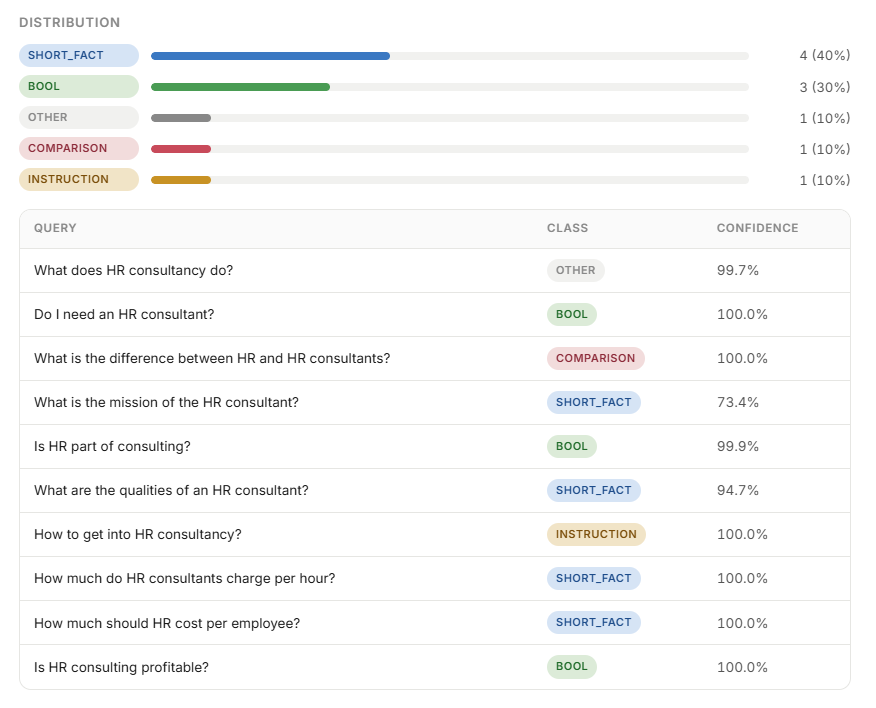
Let’s take a look at the results:
- “Do I need an HR consultant?” – BOOL, 100% confidence. Makes sense. It’s a yes/no question.
- “Is HR part of consulting?” – BOOL, 99.9% confidence. Again, entirely logical.
- “Is HR consulting profitable?” – BOOL, 100% confidence. Spot on.
- “What is the difference between HR and HR consultants?” – COMPARISON, 100% confidence. Correct – this is clearly a query about distinguishing between two things.
- “How to get into HR consultancy?” – INSTRUCTION, 100% confidence. Right again.
- “What are the qualities of an HR consultant?” – SHORT_FACT, 94.7% confidence. Reasonable – someone wants a direct answer.
- “How much do HR consultants charge per hour?” – SHORT_FACT, 100% confidence. Correct.
- “How much should HR cost per employee?” – SHORT_FACT, 100% confidence. Makes sense.
- “What is the mission of the HR consultant?” – SHORT_FACT, 73.4% confidence. Lower confidence here, which is worth noting. I’m not sure this should be a short fact either (I’m also not sure people are really searching for it, but that’s a discussion for another time).
And then there’s this one.
- “What does HR consultancy do?” – OTHER, 99.7% confidence.
The one result worth questioning
That last classification is where I’d push back a little. “What does HR consultancy do?” is, by any reasonable interpretation, a DEFINITION query. Someone doesn’t know what HR consultancy is and wants it explained. It has the structure of a “what is X” or “what does X do” question – which is precisely what the DEFINITION class covers.
The tool classified it as OTHER with very high confidence, which tells you something important about how to use this tool. It’s built on a model trained on 4.8 million real queries, and the predictions are generally pretty solid – but it’s a prediction, not a verdict handed down from Google itself. When a result looks wrong, it’s worth trusting your own understanding of what the query means and what someone searching it really wants.
Use the tool to inform your decisions, not to override your common sense.
How to use this before you write your next piece of content
The practical application for a business owner is straightforward. Before you write a page or commission content, it’s worth running your target keywords through QueryClassifier.com. Look at the classification and ask whether the content you were planning is structured the right way for that query type.
If you were planning a lengthy build-up-to-the-answer piece for a SHORT_FACT query, reconsider – lead with the answer instead. If you’re writing for a BOOL query, make sure the yes or no is front and centre. If you’re targeting a COMPARISON query, make sure you’re really comparing rather than just promoting.
Would I use this for every piece of content I write? No. Would I recommend it to my clients who are still learning about search intent and the different types of content for blog posts? Absolutely, it’s a brilliant aid.
It takes about two minutes and it’s free. Mark has done the hard work of building the tool – the least you can do is use it before you spend time writing content that’s structured for the wrong type of query.
You can find QueryClassifier.com here, and Mark Williams-Cook on LinkedIn here.
If you want help making sense of what your results mean for your content strategy, grab me on LinkedIn and I’m happy to take a look.

Don’t forget to subscribe to Mark’s Core Updates