Google announced a new Search Console feature on 7 July called platform properties, and parts of the SEO and creator world have got very excited about it. You can now connect your Instagram, TikTok, X (Twitter, forever Twitter), or YouTube account to Search Console and see how those posts perform in Google Search and Discover.
Cue the LinkedIn posts declaring a new era of social SEO.
Before you rush off to rebuild your marketing strategy around it, let’s call this what it ACTUALLY is: a reporting feature, not the future of bloody marketing. A nice reporting feature, granted. But your social posts appearing on Google isn’t new, and a dashboard telling you about it doesn’t change how any of it works.

Your social posts have been appearing in Google search for years
Google has indexed and shown social content in its results for a very long time. Search for a business name and you’ll often see their LinkedIn profile, their Instagram, a YouTube video or two. Search for a how-to topic and TikToks turn up in the results. None of that started this month.
What’s changed is visibility of the data, not visibility of the posts. Until now, you couldn’t see which searches led people to your social content because Search Console only worked with websites you could verify. Now, with platform properties, you can connect a social account and get the same kind of reporting website owners have had for years.
That’s IS really useful. It’s just not a revolution.
What the new Search Console platform properties show you
Once you’ve connected an account, you get three reports. The Performance report shows clicks, impressions, and the search terms that led people to your posts. The Insights report gives you traffic trends and your top-performing content. Achievements tracks milestones, like passing a click threshold over 28 days.
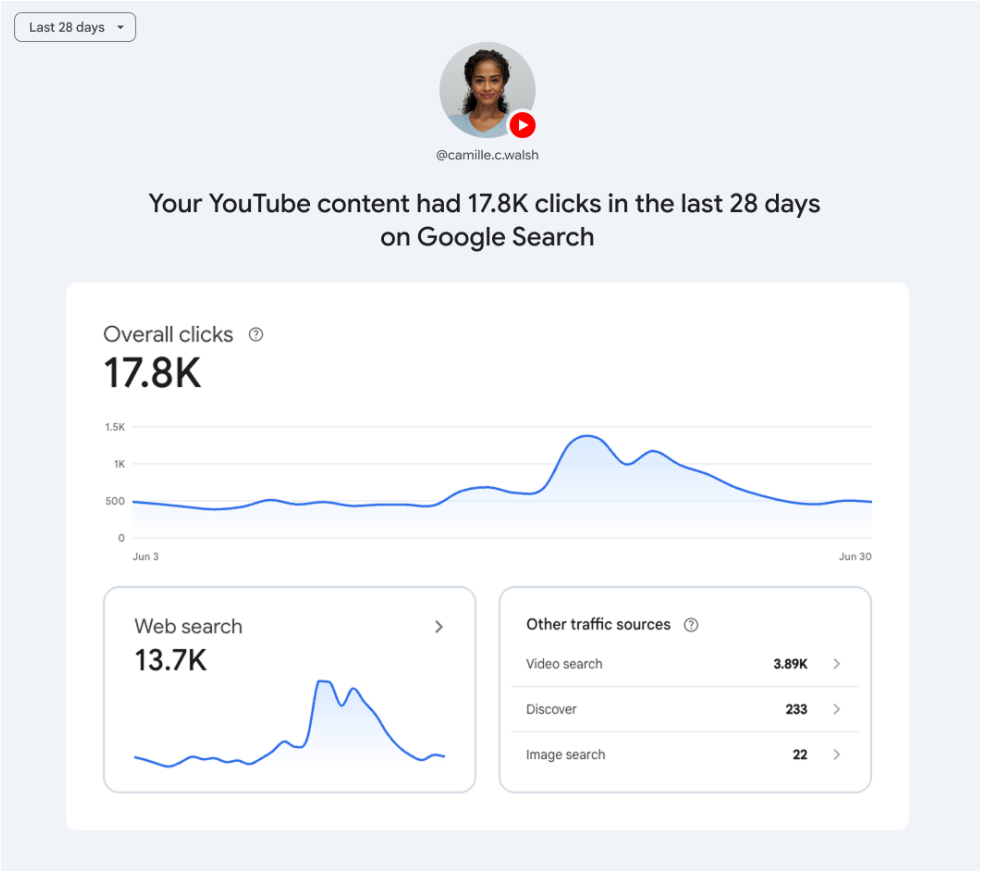
The interesting bit is that you don’t need a website at all. This is the first Search Console property type verified by connecting an account rather than proving you own a domain, which tells you a lot about who Google built it for – creators, not necessarily businesses like yours.
One thing to know before you go looking for it: the rollout is gradual over the coming weeks, so it may not be in your account yet. Most of my clients don’t have it at the time of writing. If it’s not there, you’re not doing anything wrong. Wait and check again.
How Google connects your social profiles to your business
Understanding why your social posts show up on Google in the first place needs a quick detour into something SEOs call entities.
To Google, your business isn’t just a website. It’s an entity – a thing Google understands exists in the world, with connections to other things. Your website, your Google Business Profile, your LinkedIn page, your Instagram, mentions of you on other sites, reviews – Google links all of these together into one picture of who you are and what you do.
This is why someone searching your business name sees your social profiles alongside your website. Google already knew those profiles belonged to you. It’s been building that picture for years, and your social presence has been feeding into how Google understands your business for just as long.
The new reporting doesn’t create that connection. It just lets you see one small part of it.
Why this reporting is a nice-to-have, not a strategy
More data is rarely a bad thing, and if you’re active on any of the four platforms, connecting them when you get access costs you nothing.
But some of the reactions I’ve seen suggest people think this changes what they should be doing. It doesn’t. The posts were showing up in search before. The strategy that gets social content into Google results – being useful, on platforms where your audience spends time – is the same strategy as last month, and the month before.
There’s also a less cheerful prediction to make. Give people a scoreboard and some of them will start playing to it. I suspect we’ll see more social posts written for Google rather than for the humans on the platform, more keyword-stuffed captions, more spam. Social feeds are grim enough without everyone optimising their posts for a search engine.
No LinkedIn or Facebook reporting – a strange gap for B2B
The four launch platforms are Instagram, TikTok, X, and YouTube. For a B2B service business like yours, that list is the wrong way round. LinkedIn is where most B2B social effort goes, and it’s nowhere to be seen. Neither is Facebook.
Google says the four platforms are a starting point and the list may grow. Until it does, the businesses most likely to benefit from search data about their social posts are the ones who can’t get it. Make of that what you will.
What to do about the new social reporting (spoiler: not much)
Check whether platform properties have appeared in your Search Console account. If they have and you use any of the four platforms, connect them – it takes minutes and the data might tell you something interesting about how people find you.
Then carry on as you were. Post on social because it builds relationships, demonstrates what you know, and keeps you visible to the people who might hire you. If Google sends some extra eyeballs your way, lovely. But it’s a bonus, not the whole fucking plan.
10 easy lessons, perfect on-page SEO. NOW FREE!