(This is the 21/10/2025 issue of my newsletter – subscribe here)
Hey hey!
There’s a lot of dangerous SEO advice flooding LinkedIn right now. You know the posts I mean – “Ditch your expensive SEO tools! I use these 7 ChatGPT prompts instead and saved £8,400 a year!”

Complete. And. Utter. Absolute. Bollocks.
And before you think I’m about to launch into some self-righteous rant about how you should listen to me instead – I’m not. Because I fully believe that you should stop blindly listening to people shouting their mouths off on LinkedIn, Twitter (never X), podcasts (yes, even mine), and anywhere else.
What you should be doing instead is looking at your own data, doing your own research, and making decisions based on what’s happening in YOUR business. Not what some LinkedIn gooroo with 50,000 followers reckons is the next big thing.
Speaking of shouting into the void, I’ve just launched my new podcast, SEO F**king What?, where I take apart the biggest bollocks in the SEO industry right now. The first episode is about hustlebros declaring SEO dead so they can flog you their shiny new course on whatever acronym they’ve invented this week. A future episode will tear apart these dangerous ChatGPT prompts that are supposedly going to replace your entire SEO toolkit. Find it where you usually listen to your podcasts. It’s here on Spotify, here on Apple.
It’s ranty, it’s sweary, and I wouldn’t listen to it with kids around.
Special thanks to the fantastic Neal Veglio of podcasting production and marketing company Podknows. From running with my idea, to bigging me up at every opportunity, he’s been fab, and he managed to make me sound so professional, even my mum said “Is that really you?” (Then she clipped me round the ear “for swearing” and reminded me of when she washed my mouth out with washing up liquid when I was younger. I’m 52 FFS…)
Free on-page SEO Health Check
What you’ll find inside
1 | Why ChatGPT can’t replace your SEO tools (and the people saying it can are talking dangerous shite)
2 | How to spot when “helpful” advice is setting you up to fail
3 | Your free SEO tip: Stop guessing at search intent – let Google show you
4 | What I’m working on this week
Let’s dig in, shall we?
Thoughts this week: Trust data, not dickheads
I’ve just launched a podcast where I spend 10-15 minutes shouting my opinions into a microphone. And I’m telling you right now – don’t just believe me because I’m loud and sweary.
Don’t believe anyone just because they’re loud and sweary, or polished and professional, or have a massive following, or speak at conferences, or have “20 years of experience” in their bio.
Believe your own data.
Look at what’s happening in YOUR Google Analytics. Check YOUR Search Console. Talk to YOUR customers about how they found you. Make decisions based on YOUR business, not on what’s getting engagement in someone else’s LinkedIn feed.
Because right now, there’s a particularly dangerous strain of advice doing the rounds. People are telling small business owners – people who don’t have the bullshit detector that comes from years in the industry – that they can bin their SEO tools, sack their SEO professionals, and replace them with ChatGPT prompts.
And I’d put money on the fact that the people offering this advice haven’t done it themselves. They’ve still got their Ahrefs subscription. They’re still using Screaming Frog. They’re still paying for SEMrush or SE Ranking, or whatever. But they know that “save £8,400 a year with these prompts!” is engagement gold, so they post it anyway.
The people who’ll suffer aren’t the LinkedIn gooroos. They’ll get their likes and shares and move on to the next “hot take”. The people who’ll suffer are the small business owners who follow this advice, tank their rankings, waste months on the wrong strategy, and can’t figure out why their website isn’t bringing in customers anymore.
So here’s what I’m saying – by all means, listen to my podcast (please, please, listen to my podcast😁). Read this and other newsletters. Follow whoever you want on social media. But then do your own research. Look at your own numbers. And if something sounds too good to be true – like replacing thousands of pounds worth of professional SEO tools with free ChatGPT prompts – it probably is.
Why ChatGPT can’t replace your SEO tools – and the people saying it can are talking dangerous shite
You’ve seen the posts. “I ditched my £8,400/year SEO tool subscription and now I just use these ChatGPT prompts!” Thousands of likes. Hundreds of shares. Everyone nodding along in the comments.
But, notice that these posts never show you the results. They never show you their rankings before and after. They never show you their traffic. They just show you the prompts and tell you how much money they’ve “saved.”
That’s because the results probably don’t exist. Or they’re terrible. Or – and I’d put money on this – they’re still paying for those tools themselves.
ChatGPT doesn’t have access to Google’s search data. It can’t tell you real search volumes. It can’t analyse actual ranking difficulty. It can’t crawl your website to find technical issues. It can’t show you your competitors’ backlink profiles.
What it can do is make educated guesses based on patterns it learned during training. And those guesses might sound plausible, but they’re not based on current, real-world data.
When ChatGPT tells you a keyword gets 2,000 searches per month, where did that number come from? It made it up. When it rates keyword difficulty as 45/100, what’s it measuring? Nothing – it’s just giving you a number that sounds reasonable.
Professional SEO tools aren’t perfect either – different tools give different numbers because they sample data differently. But they’re at least sampling real search data, real rankings, real websites. ChatGPT is working from memory and guesswork.
If you’re working with a tight budget, you don’t need to choose between expensive tools and unreliable ChatGPT prompts. There’s a middle ground:
Google Search Console is free and shows you what queries you’re already ranking for. Use it.
Manual keyword research takes longer but costs nothing. Look at “People Also Ask,” check Reddit or Quora threads, analyse what’s ranking.
Google Keyword Planner gives you rough search volumes for free.
There are free tiers on tools like Ubersuggest and Also Asked that give you limited but real data.
And yes, you can use ChatGPT for some things – generating content outlines once you know your target keyword, drafting meta descriptions, brainstorming title ideas. But don’t use it to decide your strategy. That needs real data.
The people posting these “ditch your SEO tools” guides know this. They’re either still using the tools themselves, or they don’t do enough serious SEO work for it to matter. But they know the posts get engagement, so they keep posting them.
Don’t let someone else’s quest for LinkedIn likes fuck up your website’s rankings.
Your free SEO tip
It’s a bit of a long one today, but it’s worth it.
Stop guessing at search intent – let Google show you
Make a list of the key phrases you want people to find your site for. Not single keywords – actual phrases your customers might search. Things like “B2B copywriter for tech companies” or “web designer for professional services firms.”
Then go to Google and manually search for them. Open the top 10 results. All of them. And look at what Google is showing you.
Because keywords and phrases are just your starting point. Intent is what you need to focus on. And Google has enough data to think it knows what people want when they search certain things.
To fight for rankings among those results, you have to be writing similar content that serves the same intent. There’s no point writing a full-on sales page aimed at a search phrase if Google is showing 10 forum discussions. Or writing a ‘how to’ blog post if Google is showing 10 agency portfolios.
Let me give you some examples:
Example 1: “Website copy” – If the top 10 results are all guides like “How to write better website copy” and “10 tips for effective web copy,” Google thinks people want to learn to do it themselves. Writing a page that says “Hire me to write your website copy” won’t rank because you’re not serving the intent. You’d need to write that educational guide instead, then convert readers with a subtle CTA.
Example 2: “Brand messaging framework” – If the results are all downloadable templates and DIY guides, people want tools they can use themselves. Your service page about “We’ll develop your brand messaging” is fighting against the intent. But a blog post titled “Brand messaging framework template (with examples)” that offers a free download? That matches what Google thinks people want.
Example 3: “SEO audit” – If the top results are all free tools and checklists for doing your own audit, that’s DIY intent. Your “Book an SEO audit” service page won’t rank there. But if the results are all agencies offering professional audits, then your service page fits perfectly.
Example 4: “WordPress website designer” – If the results are portfolio sites and case study pages from designers, people are looking to hire. Writing a blog post about “What makes a good WordPress designer” won’t compete. You need a portfolio-style page showing your work.
Example 5: “Improve website conversion rate” – If Google is showing articles like “15 ways to improve your conversion rate” and blog posts with tips, people want information, not services. Your “Conversion rate optimisation services” page won’t rank. Write the tips article instead, then mention your services at the end.
This is why keyword research alone isn’t enough. You need to know what type of content Google rewards for each phrase. And the only way to know that for certain is to look at what’s ranking.
This costs you nothing except time. No tools needed. Just Google and your eyeballs. But it’ll stop you wasting months creating content for phrases that’ll never bring you the right visitors, even if you rank for them.
What am I working on this week?
Something interesting I’ve noticed lately – a lot of SEO freelancers have been booking 1:1s with me. Not for their clients, but for themselves.
They want to talk about how they approach AI search with clients, to double-check they’re on the right track with recent projects, to troubleshoot issues they’re having, or just to get some help growing their SEO business.
It’s fab and I love it. It’s nice to chat to other SEO professionals among the usual landing page writing, SEO retainers, and general SEO stuff.
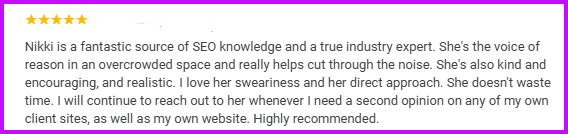
If you’re an SEO freelancer who needs a sounding board, or you want to pick my brain about something specific, you can book a 1:1 here.
Need help with SEO? You know where to find me.
That’s it for now,
Always non-wanky,
Nx
P.S. Give that search intent check a try this week – pick your top 3 target phrases and see what Google is showing you. You might discover you’ve been trying to rank a sales page for a phrase where everyone wants a how-to guide. Five minutes of research now could save you months of wondering why your perfectly optimised page isn’t ranking.