OpenAI has launched Businesses in ChatGPT, which means you can now claim your business inside ChatGPT and see how often it mentions you and how many people click through to your website.
It’s in beta, and OpenAI would very much like you to know that 1.2 billion people use ChatGPT every week (it’s in the first sentence, in case you missed it). I’m far more interested in the numbers on the dashboard. For the first time they come from OpenAI, rather than from someone selling you a tool that guesses.
Sadly, it appears to be US only right now, as I was put straight on a waiting list – so if you’re hoping to log in and see your stats by Friday afternoon, I wouldn’t put the kettle on for it just yet. More on the claiming bit further down…
What ChatGPT Business Hub shows you about your AI visibility
According to Digiday, you get four things: mentions, views, website clicks and something OpenAI calls discovery topics. Discovery topics are the themes that come up across conversations where your website gets cited. You’d see something along the lines of “B2B website migrations”, not the exact question someone typed in. You can look at the last 7 or 28 days. A click is just a click on a link to your site, so it won’t tell you whether anyone hung around or bought anything.
You won’t see anyone’s conversations either. OpenAI says the insights are aggregated and only show up once there are enough conversations to meet its privacy thresholds. For a lot of small B2B businesses that could mean a pretty empty dashboard for a while. That’s worth knowing before you get excited, and it’s no reflection on how good you are at what you do.
If you’d like help working out what your numbers mean once they turn up, book an SEO 1:1 and we’ll go through them together.
How ChatGPT counts a mention compared with Google and Bing
OK, this is where it gets a bit annoying, because every platform now counts AI visibility in its own way and none of them agree.
Google’s Search Console report only counts an impression when a visible link to your site appears in an AI Overview or AI Mode answer. Three glowing sentences about your business with no link count for nothing. I went through the detail in how Google counts impressions in AI Overviews and AI Mode.
Bing counts citations, meaning how often your pages are shown as a source in Copilot and its AI summaries. I covered that when Bing Webmaster Tools started showing how often AI cites your content.
ChatGPT’s version sits somewhere in between. Digiday reports that an online business gets a mention when ChatGPT references its website, and a local business gets one when ChatGPT shows it as a result for its area. ChatGPT just saying your brand name doesn’t count.
Then there are the third-party AI visibility tools. Most of them count how often your brand name pops up in answers to a list of prompts they picked themselves. That makes four different definitions, and that last one is an educated guess.
I’ve banged on about GEO being SEO with a new badge for so long that you’re probably sick of me. This is the bit I AM chuffed about, though. If someone has waved a scary AI visibility score at you to sell you a fix, you’ll soon have ChatGPT’s own figure to hold up next to it. Farhad Divecha at Accuracast told Digiday that if the tools’ estimates turn out to be wildly off, “that will make us rethink paying for those tools”. I suspect a fair few small business owners paying monthly for one of those tools will be thinking the same.
Is ChatGPT Business Hub the new Google Business Profile?
Pretty much, at least for now. You claim your business, prove you’re allowed to represent it, keep your details right and have a look at the insights every so often. If you’ve ever wrestled with a Google Business Profile, none of this will feel new (and hopefully the verification is quicker than waiting for a postcard).
You can also add product feeds with prices and availability, which matters more for ecommerce than for B2B service businesses. For most of my clients the job is simpler. Check that what ChatGPT says about you is right, and make sure your website clearly says what you do and who you do it for, because your website is what ChatGPT cites.
I get it, a shiny new dashboard feels like one more thing you have to learn, and it’s easy to assume that claiming the profile is the job. Claiming your profile won’t fix a website that doesn’t explain what the hell you sell. OpenAI also told Digiday that taking part doesn’t change how often a business gets recommended. That’s more or less what I said in SEO myth: local SEO is just about Google Business Profile: the profile helps, but your website is doing the heavy lifting.
How to claim your business in ChatGPT from the UK
Any eligible business in a country where ChatGPT is available can claim its listing.
Start at Business Hub and search for your business name.
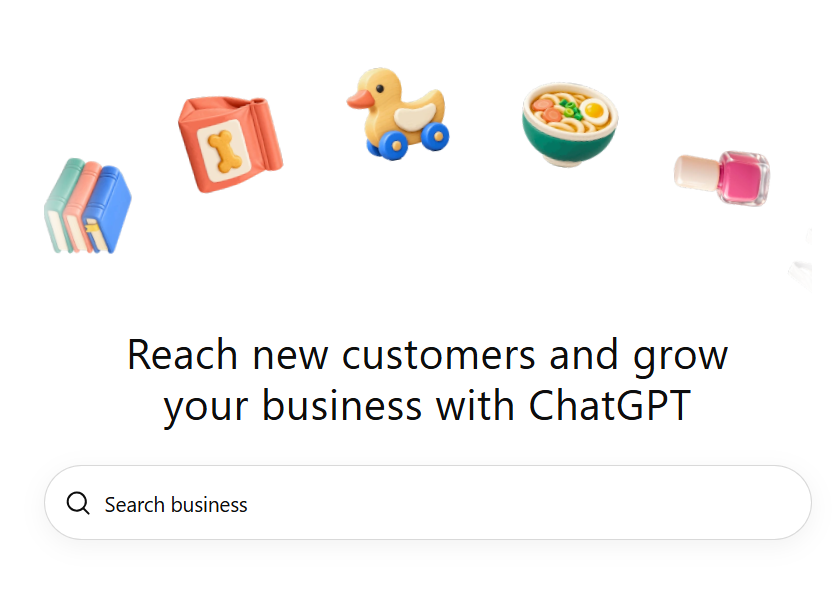
ChatGPT may already know who you are. Mine popped up straight away (it’s always nice to be recognised). If yours isn’t listed, there’s an option to create it.
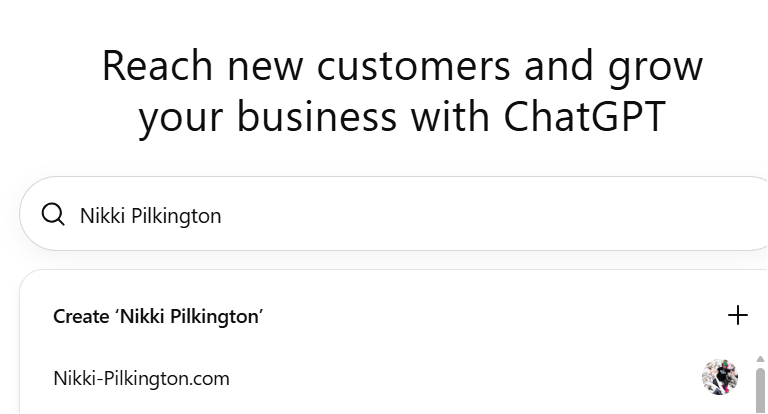
Choose your business and you’ll get a screen explaining what claiming it gives you. It also tells you you’ll need to verify that you’re authorised to represent the business.
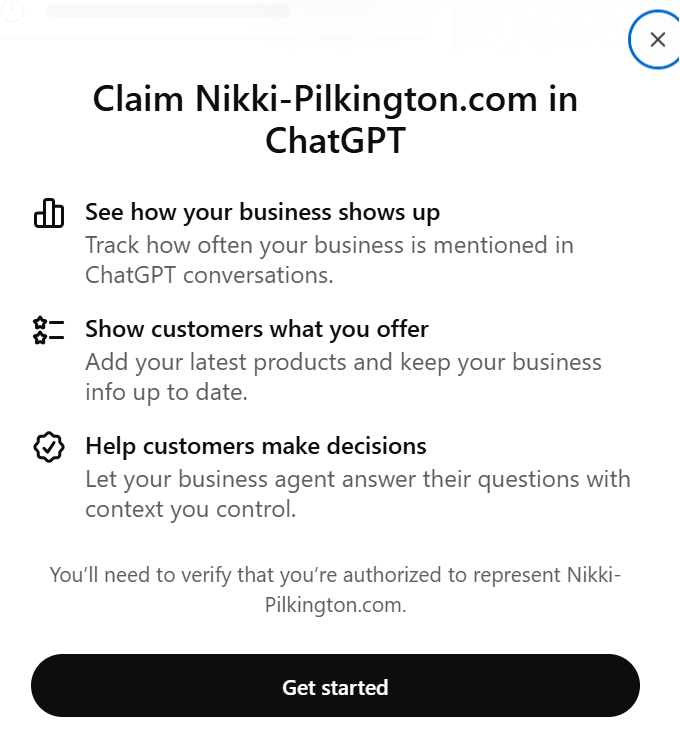
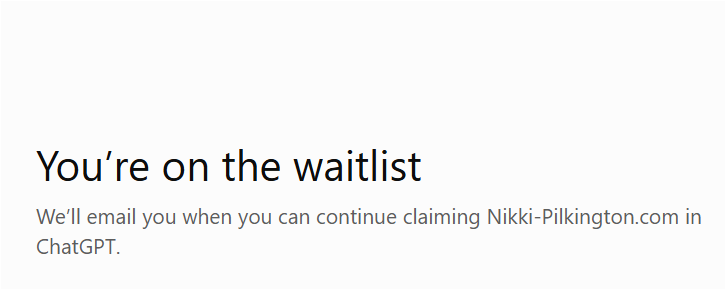
After that, for me anyway, came “You’re on the waitlist” and a promise of an email when I can carry on. I’ve no idea yet how long the wait is or what verification involves, so I’ll update this post when I get through.
If you’re on Shopify, you can connect your store from Business Hub or the Shopify admin to speed up verification. Businesses that are already OpenAI Enterprise customers or advertisers go through their OpenAI rep instead.
Business Agents and sponsored placements in ChatGPT
Once you’ve claimed your business, you may be able to build a Business Agent. It’s a chat assistant that answers people’s questions about what you offer, using your information, in a labelled conversation separate from ChatGPT’s own answers. Right now it’s only open to US ecommerce and online service businesses, so most of us in the UK can park it for now. Digiday reports that OpenAI builds and hosts the agent. You give it instructions and a product feed, and it sends buyers to your website to pay.
The agent itself is free. There’s also a sponsored version, where you pay to make your agent the destination for ChatGPT Ads (it’s labelled as sponsored, to be fair to them). When ChatGPT ads first appeared, I wrote that AI search isn’t killing Google, it’s copying it. This follows the same pattern of a free listing first and a paid way to get seen sooner after. I’m not saying don’t bother. I’d just keep half an eye on how much of what people see in ChatGPT ends up being paid for over the next year or so.
I’m on the waiting list with everyone else, and I’ll update this post as soon as I’m through. In the meantime, if you’d like a hand making sure your website is worth citing when your turn comes, book an SEO 1:1.