Update July 2026: now there’s data to back the slide up
When I published this in April, the evidence was Google telling us what it wants. Now someone’s measured what’s happening.
A study from Flying V Group compared pages earning AI search traffic against pages earning traditional organic traffic, and found the AI-cited pages consistently contain less commodity content. The pages AI systems pick out are the less-saturated ones – the ones saying something that doesn’t already exist on a hundred other websites. Semrush found something similar earlier in the year: AI engines rarely cite generic content that restates what other sources already say.
(Yes, they’re an agency, and yes, the study launches a tool they’d like you to join a waitlist for – but the finding matches what Semrush reported earlier in the year, so I’m inclined to believe the data even if I raise an eyebrow at the timing.)
So this is no longer just Google’s advice about what it would like to reward. It’s measurable behaviour. The wear pattern analysis beats the top ten list in AI search for the same reason it beats it everywhere else – it’s the only one of its kind.
Everything below still applies. If anything, the case has got stronger since April.

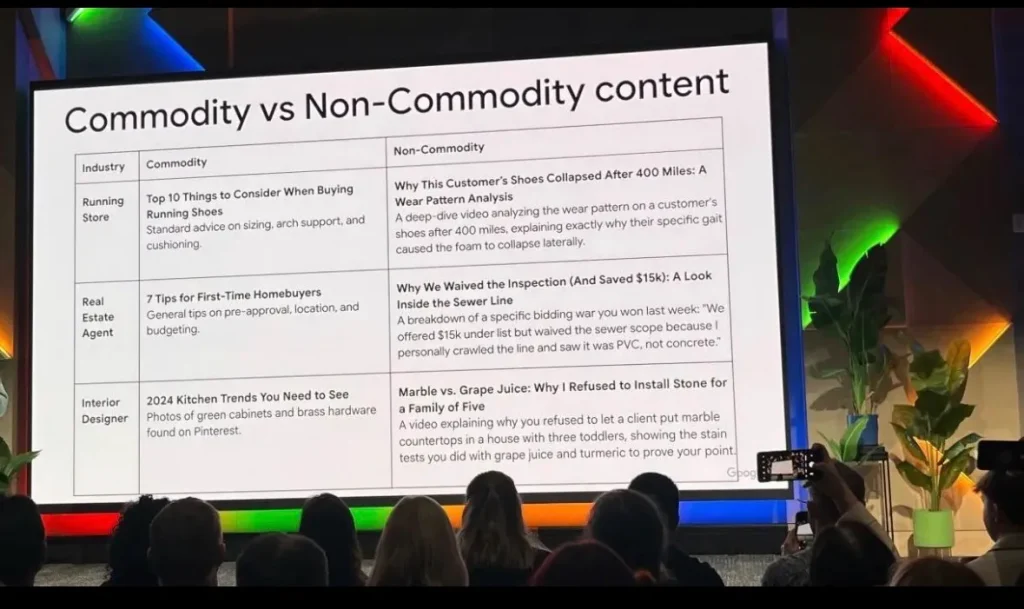
You’ve probably seen this slide doing the rounds on social media. Danny Sullivan of Google, talking at Google Search Central Live in Toronto, showing a table with two columns – commodity content on the left, non-commodity on the right. The context being that non-commodity content is more likely to be indexed in Google than commodity content.
Jean-Christophe Chouinard shared the screenshot, and many others from the day, here.
Lots of people shared it, commented on it, and nodded along – of COURSE this makes sense, we KNOW this – and then went right back to writing “5 things to consider when choosing insert service they sell here.”
So let’s think properly about what this means, rather than just giving a screenshot a thumbs up and moving along.
What the “commodity vs non-commodity content” slide shows
The slide uses three industry examples.
The running store
For a running store, commodity content is shown “Top 10 Things to Consider When Buying Running Shoes” – standard advice on sizing, arch support, cushioning. The non-commodity version is “Why This Customer’s Shoes Collapsed After 400 Miles: A Wear Pattern Analysis” – a deep dive into why one specific person’s gait caused the foam to collapse laterally.
The real estate agent
For a real estate agent, commodity is “7 Tips for First-Time Homebuyers.” Non-commodity is “Why We Waived the Inspection (And Saved $15k): A Look Inside the Sewer Line” – a breakdown of a specific bidding war, with the agent explaining they personally crawled the line and saw it was PVC, not concrete.
The Interior Designer
For an interior designer, commodity is “2024 Kitchen Trends You Need to See.” Non-commodity is “Marble vs. Grape Juice: Why I Refused to Install Stone for a Family of Five” – a video showing the stain tests they did with grape juice and turmeric to prove the point.
It’s easy to see the difference, right? The commodity content could have been written by anyone. The non-commodity content could only have been written by that specific business, about that specific situation.
Why Google is telling you this
This isn’t Danny Sullivan sharing a personal preference, and this isn’t the first time he’s talked about this kind of thing. This is Google telling you directly what kind of content it wants to reward – and has wanted to reward for years, it’s just that this slide makes it clearer than it has been in the past.
E-E-A-T (Experience, Expertise, Authoritativeness, Trustworthiness) has been part of how Google evaluates content for a long time. The first E – Experience – is the one most people overlook. All it means is have you actually done the thing you’re writing about?
A post about the top ten things to consider when buying running shoes demonstrates knowledge. A post about why a specific customer’s shoe failed after 400 miles demonstrates experience. One of those is harder to fake. One of them could usually only exist if the person writing it was actually there.
Commodity content is interchangeable by definition. The same advice appears on a hundred websites and there’s no particular reason for Google to rank yours over anyone else’s. Non-commodity content exists nowhere else, because it comes from something that only happened to you.
Commodity content doesn’t differentiate you from your competitors
I worked with a cybersecurity company that had a very clear idea of what their blog should cover: ISO standards. ISO 27001, ISO 27002, compliance guides, explanatory posts. Solid topics that really were relevant to their clients. Lots of “What is…” and “How do I…” type content – all good stuff not that long ago.
The problem was that every other cybersecurity company was writing the same things. And because there are only so many ways to write about these things, the only thing that really changed was the order of the words. They were producing a shit-tonne of commodity content that on the surface had nothing wrong with it, and couldn’t work out why it wasn’t gaining traction.
What they weren’t writing about was the actual work. The client who came to them six weeks before a major audit having done almost nothing. What the gap analysis found. How they prioritised remediation. What got signed off in time and what had to be handled differently. That story exists nowhere else. No competitor can write it. And any potential client staring down a similar situation would find it far more useful than another explanation of what ISO 27001 is.
How to work out what your non-commodity content could be
The next time you sit down to write your content plan, don’t ask “what topics should I cover?”, ask “what have I actually done that I could write about honestly?”
Think about the last time a client came to you with a problem that was messier or more specific than usual. The decision you made that wasn’t the obvious one. The time something didn’t go to plan and you fixed it. The recommendation you gave that turned out to be right for reasons you only understood afterwards.
That’s the raw material – the specific situation, the specific reasoning, the specific outcome. Not a summary of general principles
You don’t need to name the client. You don’t need to share anything confidential. But the detail has to be real. Real enough that someone reading it thinks “this person has actually been in this situation.” The grape juice test, the sewer pipe, the shoe foam – those details are there because they prove the writer was present.
And before you say “I don’t want to give away my expertise for free.”, remember there’s a difference between writing a post that teaches someone to do your job themselves, and writing a post that shows them you know what you’re doing. Both of those posts will show expertise, but only one of them proves experience.
How to find non-commodity content ideas
Go back through the last six months of client work, emails, or notes. Look for moments where you did something specific – recommended something unexpected, spotted something others had missed, dealt with something that didn’t go the standard way.
Write that up. Keep the detail. Don’t generalise it into a listicle or sand off the specifics to make it feel more “broadly applicable.” The specificity is the fucking point.
If there’s a general principle worth drawing out, fine – but lead with the situation because that’s what Google is telling us in that slide. More usefully, it’s what a potential client reading your blog post while looking for a solution to their problem will remember.
If you want help working out where the gaps are in your content and what your non-commodity version could look like, an SEO 1:1 is a good place to start.